Tissue Paper Insert vs Wrap: Which Style Suits Your Product Best?
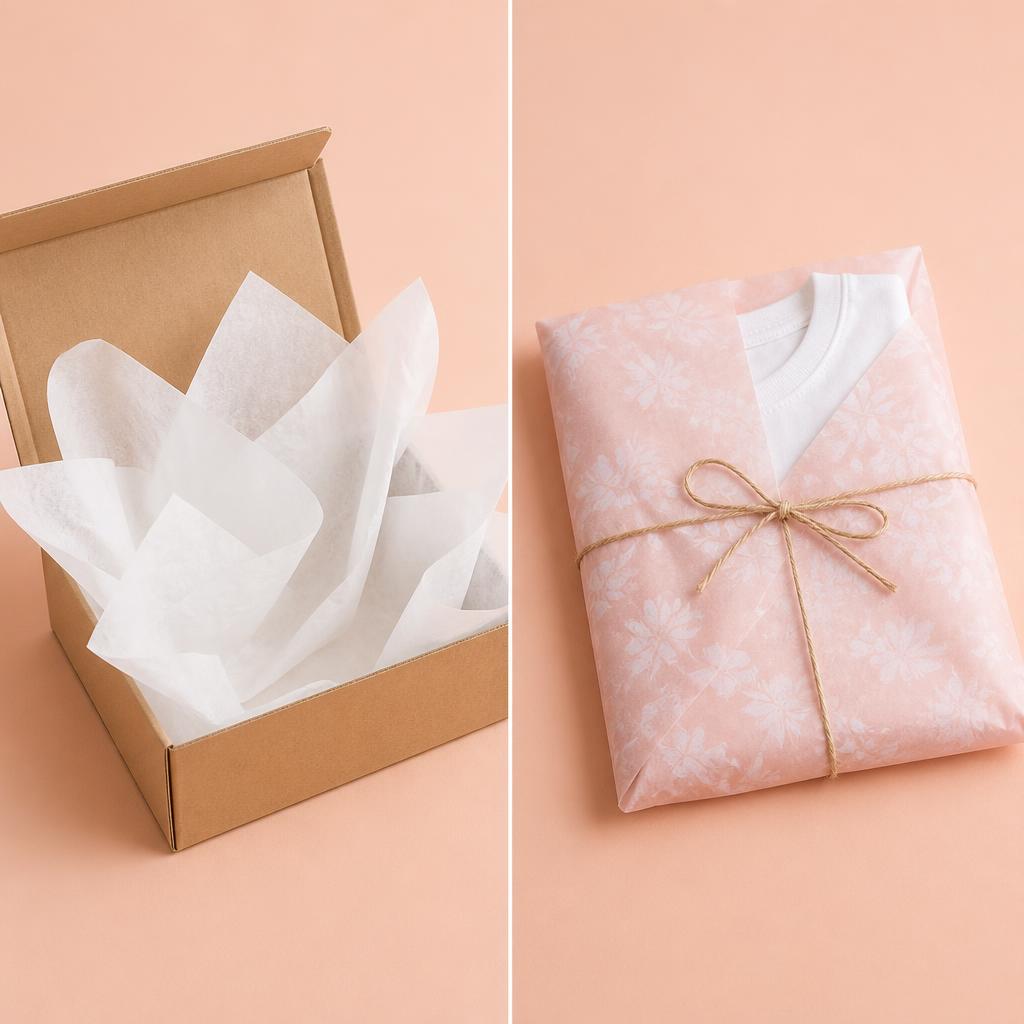
There are basically two ways to use printed tissue paper inside a parcel. You can fold it as an insert that sits on top of the product, or you can wrap the product fully and tuck or seal the edges.
Both look great. Both are cheap. They send completely different signals.
This guide pins down when to use each, what each one costs you in time at the packing bench, and how to fold them so they actually open the way you want.
The insert: tissue as a top layer
The insert style is the quickest. One sheet, folded once or twice, laid on top of the product inside the box. Often paired with a sticker or paper seal in the centre.
It''s the style favoured by:
- Fashion brands shipping folded garments
- Subscription boxes with several items inside
- Premium food and drink with multiple products
- Anyone packing 30+ parcels a day where every second counts
Pros:
- Fast. Two to three seconds at the bench.
- Looks intentional with very little folding skill.
- Works with stickers, wax seals or branded tape as a focal point.
- Lets customers see the product silhouette as soon as they open the lid — useful for clothing.
Cons:
- Doesn''t protect the product on its own. You still need cushioning inside.
- Less of a "reveal" — the product is half visible immediately.
The wrap: tissue as a parcel
The wrap is the classic boutique style. The product is fully encased in one or two sheets, folded around it neatly, edges tucked or sealed with a sticker on top.
Favoured by:
- Boutique fashion and accessories
- Beauty and skincare with single-product gifts
- Wedding favours, gifting and special editions
- Anyone selling something that should feel like a small ceremony to open
Pros:
- Adds a true reveal moment. The customer has to undo it before seeing the product.
- Doubles as soft cushioning around fragile items.
- Photographs and films beautifully — the moment the sticker breaks is the keeper shot.
- Feels significantly more expensive than the insert, for the same number of sheets.
Cons:
- Slower at the bench — 10 to 20 seconds per parcel until staff get good at it.
- Needs a slightly larger sheet relative to the product.
- Hard to do well with stiff or oddly shaped items.
Which one fits your product?
A rough rule of thumb:
- Single hero product per parcel? Wrap it.
- Multiple items in one box? Insert on top, wrap the hero.
- Fast-moving, high volume? Insert.
- Gifting, weddings, launches? Wrap.
- Fragile glass or ceramic? Wrap, with extra sheets crumpled around.
You don''t have to pick one forever. Plenty of brands use the wrap style for retail orders and switch to inserts for wholesale shipments where speed matters more than spectacle.
Folding a clean wrap in 15 seconds
Once you''ve done a few hundred you''ll have your own rhythm, but here''s the version that works for most products:
- Lay a 500 × 750mm sheet flat on the bench, printed side down.
- Place the product in the centre, slightly off-set toward you.
- Bring the top edge over the product, then the bottom edge up over the top.
- Tuck the left and right edges underneath, like you''re wrapping a gift.
- Flip the parcel over so the printed side faces up.
- Finish with a centred sticker, wax seal or strip of branded tape.
The flip in step 5 is the trick most people miss. It hides every imperfect fold and gives you a clean printed face for the sticker.
How many sheets do you actually need?
For an insert: one sheet per parcel.
For a wrap: one sheet for small items (jewellery, single skincare bottle), two for larger items (folded shirt, small ceramic). For luxury gifting or fragile items, three sheets isn''t excessive.
Plan your reorder cycle around how many parcels you ship per week, not how many sheets sit on the shelf. Tissue is forgiving — it stores flat for years if you keep it dry.
Print design for each style
Inserts show one or two folds. Centred logos work. So do bold patterns that read at a glance.
Wraps fold in unpredictable ways. Repeating patterns and edge-to-edge designs work much better than a single centred logo, which often ends up tucked under or against the bench.
If you''re ordering one design to use for both, default to a repeating pattern. It will look right no matter how it folds.
The decision
If you''re shipping fewer than 50 parcels a day and want each one to feel like a gift, wrap. If you''re shipping more than 200, or you sell multi-item boxes, insert. If you''re in between, mix the two — wrap your gift orders and insert your everyday ones.
Either way, printed tissue beats plain every time.
Make it your own
Design a sheet in our builder — pick the size, weight and print colours, and we''ll ship in 7 days. Or get a quote if you want help choosing.