Spot Colour vs CMYK Printing for Custom Tissue Paper: Which Should You Choose?
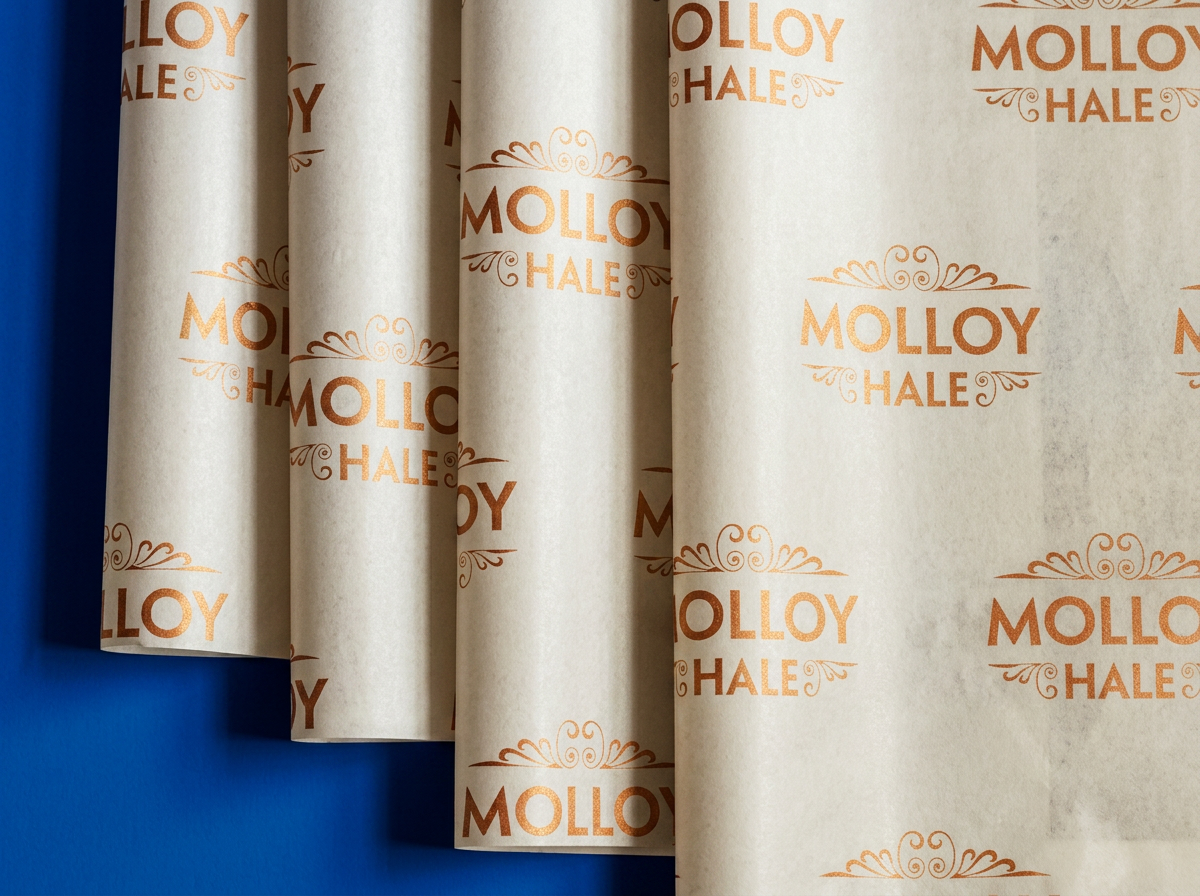
When ordering custom printed tissue paper, one of the most important decisions you'll make is choosing between spot colour (flexographic) printing and CMYK (full colour digital) printing. Each method has distinct advantages, limitations, and cost implications that can significantly affect the outcome of your project.
This comprehensive guide breaks down everything you need to know to make the right choice for your brand.
Understanding the Fundamentals
Before diving into comparisons, let's establish exactly what each printing method involves.
What Is Spot Colour Printing?
Spot colour printing — also known as flexographic or flexo printing — uses custom-mixed inks matched to specific Pantone colour references. Each colour in your design requires its own printing plate (called a cliché or flexo plate), which is mounted on a cylinder and used to apply ink directly to the tissue paper.
Think of it like a highly sophisticated rubber stamp: each colour is applied as a separate pass through the press, building up the final design one colour at a time.
Key characteristics:
- Uses Pantone Matching System (PMS) colours for exact colour reproduction
- Each colour requires a separate printing plate
- Typically accommodates 1-4 colours per design
- Produces consistent results across very large print runs
- Industry standard for tissue paper printing worldwide
What Is CMYK Printing?
CMYK stands for Cyan, Magenta, Yellow, and Key (Black) — the four process colours that, when combined in varying proportions, can reproduce virtually any colour in the visible spectrum. This is the same technology used in your home or office printer, but at an industrial scale.
Digital CMYK printing for tissue paper uses high-resolution printheads that deposit tiny droplets of these four inks onto the paper surface, creating full-colour images through a process called halftoning.
Key characteristics:
- Uses four process colours to create full colour spectrum
- No printing plates required
- Can reproduce photographic images and complex gradients
- Ideal for shorter print runs and variable designs
- Growing in capability and quality each year
Quality Comparison
Colour Accuracy
Spot Colour: When it comes to reproducing a specific brand colour with absolute precision, spot colour printing is unmatched. Because each ink is custom-mixed to match your Pantone reference, you get exact colour reproduction every time. This is critical for brands with strict colour guidelines — if your brand blue needs to be Pantone 2768 C, spot colour printing guarantees that's exactly what you'll get.
CMYK: While CMYK can reproduce a vast range of colours, it does so by mixing four process colours. This means certain colours — particularly vibrant oranges, deep purples, and specific brand colours — may not be reproduced with 100% accuracy. The difference is often subtle, but for brands with exacting colour standards, it can be noticeable.
Winner: Spot Colour for brand-specific colour accuracy
Detail and Resolution
Spot Colour: Flexographic printing excels at crisp, clean lines and solid colour areas. Logos, text, and geometric patterns look sharp and well-defined. However, it's limited in its ability to reproduce fine gradients, photographic images, or designs with many colour transitions.
CMYK: Digital printing can reproduce fine details, photographs, and smooth gradients that would be impossible with spot colours. If your design includes product photography, illustrated scenes, or complex colour transitions, CMYK is the only viable option.
Winner: CMYK for complex designs; Spot Colour for clean, graphic designs
Consistency Across Runs
Spot Colour: Once the ink is mixed and the press is running, spot colour printing delivers remarkable consistency across thousands of sheets. Whether you're printing 500 or 50,000 sheets, the colour will remain uniform throughout the run and will be consistent when you reorder in the future.
CMYK: Digital printing can experience minor variations in colour across a large run, as the printhead output can drift slightly over time. Modern presses have calibration systems that minimise this, but slight variations are inherent in the process.
Winner: Spot Colour for large-run consistency
Cost Analysis
Understanding the cost structure of each method is crucial for making an informed decision.
Setup Costs
Spot Colour: Requires custom printing plates to be manufactured for each colour. These plates represent a one-time cost that is amortised over the print run. For a two-colour design, you'll need two plates; for four colours, four plates. Plate costs vary but typically range from £150-£400 per plate depending on size and complexity.
CMYK: No plates are required, which means zero setup costs. This is one of the biggest advantages of digital printing, particularly for short runs or one-off projects.
Per-Sheet Costs
Spot Colour: Once the plates are made and the press is running, the per-sheet cost drops significantly with volume. For large runs (5,000+ sheets), spot colour becomes extremely cost-effective — often just a few pence per sheet.
CMYK: The per-sheet cost remains relatively consistent regardless of volume. While this makes it competitive for short runs, it becomes proportionally more expensive at higher volumes compared to spot colour.
The Break-Even Point
For most projects, there's a break-even point where spot colour becomes more cost-effective than CMYK. This typically occurs around 2,000-3,000 sheets for a simple two-colour design. Below this quantity, CMYK is usually more economical; above it, spot colour wins on per-sheet cost.
When to Choose Spot Colour
Spot colour printing is the best choice when:
- Brand colour accuracy is paramount: You need exact Pantone colour matching
- Your design uses 1-4 colours: Simple logos, patterns, and text work beautifully
- You're ordering large quantities: Volumes above 2,000-3,000 sheets benefit from lower per-sheet costs
- Consistency matters: You need identical results across multiple orders over time
- Your design features solid colour areas: Spot colours produce beautifully uniform, solid fills
Ideal Spot Colour Projects
- Logo scatter patterns in brand colours
- Monochrome or two-tone repeating patterns
- Text-based designs with precise colour matching
- Classic, elegant designs with clean lines
When to Choose CMYK
CMYK printing is the best choice when:
- Your design includes photographs: Product images, lifestyle photography, or illustrated scenes
- You need full-colour gradients: Designs with colour transitions, ombre effects, or rainbow elements
- You're ordering smaller quantities: Runs under 2,000 sheets benefit from no plate costs
- You want design flexibility: Easy to change designs between orders without plate costs
- Your design uses many colours: Designs with 5+ colours are impractical with spot colour
Ideal CMYK Projects
- Photographic tissue paper featuring product images
- Illustrated patterns with many colours
- Seasonal or limited-edition designs that change frequently
- Prototype or test runs before committing to large spot colour orders
Making Your Decision
Here's a simple decision framework:
- Does your design include photographs or complex gradients? → Choose CMYK
- Do you need exact Pantone colour matching? → Choose Spot Colour
- Are you ordering fewer than 2,000 sheets? → CMYK is likely more economical
- Are you ordering more than 3,000 sheets? → Spot Colour is likely more economical
- Will you reorder the same design regularly? → Spot Colour offers better long-term value
If you're unsure which method is right for your project, our team can review your artwork and recommend the best approach. We offer a £20 artwork review service where we'll prepare your files and advise on the optimal printing method for your design and budget.
The Future of Tissue Paper Printing
The printing industry is evolving rapidly, and tissue paper printing is no exception. Digital printing technology continues to improve in quality and speed, narrowing the gap with flexographic printing. Some manufacturers are now offering hybrid approaches that combine the colour accuracy of spot colours with the flexibility of digital printing.
Regardless of which method you choose today, investing in custom printed tissue paper is one of the smartest branding decisions you can make. The right printing method simply ensures you get the best possible result for your specific needs and budget.
For a deeper look at how spot colour and CMYK work on different paper weights, see our printing methods guide. The British Printing Industries Federation has useful technical resources on flexographic printing standards.