How Many Sheets of Tissue Paper Do I Need?
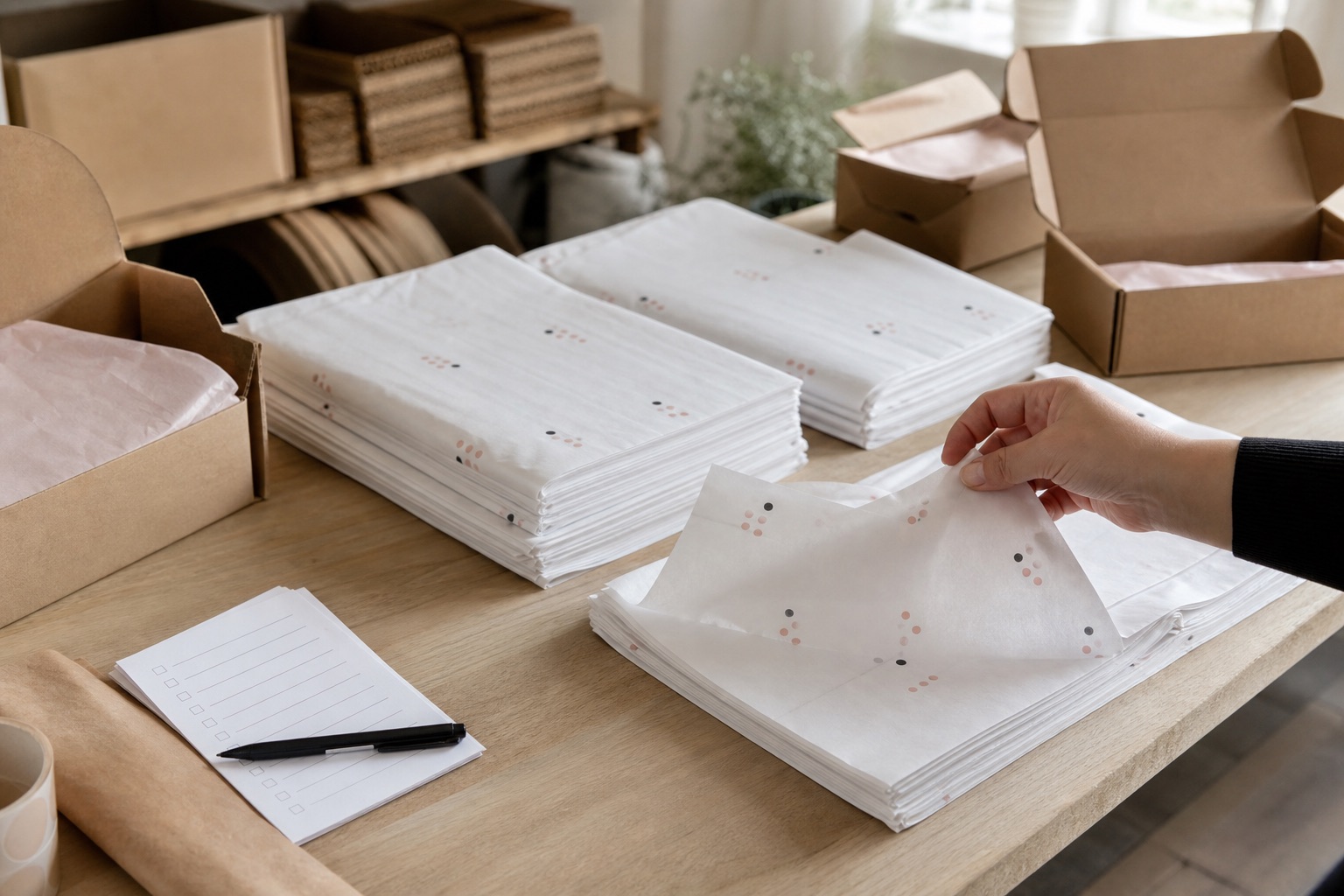
Buying too little tissue paper creates an avoidable packing problem. Buying far too much ties up cash, fills shelves and becomes painful when your branding changes. The useful answer is not “order as many as you can afford”. It is to estimate how many sheets your operation will actually consume, add a realistic safety margin and choose the nearest sensible production quantity.
Here is the basic calculation:
Monthly orders × average sheets used per order × months of cover = expected sheet requirement
Then add an allowance for samples, packing mistakes, damaged sheets and unusually large orders. For most established packing processes, 5–10% is a sensible planning allowance. A new team or a product mix with very different sizes may need more until the process settles.
This guide shows you how to calculate the number properly, including the details that simple online calculators tend to miss.
The quick tissue paper quantity formula
Start with four numbers:
- The number of orders or purchases you pack in an average month.
- The average number of tissue sheets used in each order.
- The number of months of stock you want to hold.
- Your expected wastage percentage.
Use this formula:
Orders per month × sheets per order × months of stock × wastage factor
If your wastage allowance is 10%, the wastage factor is 1.10.
For example, a clothing brand sends 180 orders each month, normally uses two sheets per parcel and wants four months of stock:
180 × 2 × 4 × 1.10 = 1,584 sheets
That business should compare the 2,000-sheet tier with the cost and inconvenience of ordering 1,000 sheets more frequently. It should not automatically round down to 1,000 simply because that number sounds tidy.
How many sheets should you use per order?
This is the part that deserves a physical test. The right number depends on the product, sheet size and way the tissue is used.
One sheet per order
One sheet often works when:
- A small box is lined rather than fully wrapped.
- A jewellery pouch or cosmetics carton is folded inside a correctly sized sheet.
- Tissue is used as a neat top layer under the box lid.
- A retail purchase needs a light presentation wrap rather than transit protection.
One sheet is economical, fast and visually clean. It only works when the sheet is proportionate to the item. Trying to wrap a bulky garment in one undersized sheet produces exposed corners and torn folds.
Two sheets per order
Two sheets are common for:
- Folded clothing and knitwear.
- Medium ecommerce boxes.
- A base liner plus a top presentation sheet.
- Two individually wrapped products in the same parcel.
- Lightweight tissue where a little more opacity is wanted.
Do not assume two sheets must be stacked directly on top of one another. One sheet can wrap the product while the second lines the box or separates items.
Three or more sheets per order
Three or more sheets may be appropriate for:
- Large or irregular products.
- Several items packed separately.
- Hampers with multiple compartments.
- Fragile surfaces that need separation from other products.
- Premium retail wrapping where folds and gathers are part of the presentation.
Tissue is not a substitute for structural protection. A glass bottle may need a tissue presentation layer, but it still requires a suitable box and protective system that prevents movement and impact. Adding five more sheets of tissue does not turn it into protective foam.
Run a real packing test before calculating
Do not estimate sheet usage from memory. Pack ten representative orders and record what happens.
Choose a mixture that reflects your actual sales:
- Your smallest common order.
- Your largest common order.
- Your most frequently sold product.
- A multi-item order.
- A gift order, if gift wrapping is offered.
For each test, record:
- Sheet size.
- Sheets used.
- Whether a sheet was cut down.
- Whether any sheet tore or was discarded.
- Packing time.
- Whether the finished parcel looked consistent.
Add the total sheets used and divide by the number of test orders. That gives your working average.
Suppose ten orders consume 17 sheets. Your average is 1.7 sheets per order. For planning, you can use 1.7 rather than rounding every order up to two. Your stock calculation is an operational average, not an instruction that every parcel must use exactly the same amount.
Allow for your product mix
A single average works well when most orders are similar. It can mislead a business that sells products at very different scales.
Imagine a gift shop where:
- 60% of orders use one sheet.
- 30% use two sheets.
- 10% use four sheets.
The weighted average is:
(0.60 × 1) + (0.30 × 2) + (0.10 × 4) = 1.6 sheets per order
Using a flat assumption of one sheet would cause repeated stock shortages. Assuming four sheets would dramatically overstate the need. The weighted average reflects how the business actually sells.
If product categories change seasonally, calculate a normal-period average and a peak-period average separately.
How much safety stock should you add?
Safety stock protects you from small forecasting errors and sudden demand. It is not an excuse to ignore stock for months.
A 5% allowance may be sufficient when:
- The packing method is standardised.
- Order volume is predictable.
- Reordering is straightforward.
- The team has used the same tissue for a long time.
A 10% allowance is more prudent when:
- New staff are learning the wrap.
- The business is growing quickly.
- Product sizes vary.
- Seasonal peaks are meaningful.
- Tissue is also used for displays, events or samples.
A larger allowance can make sense for a launch or a fixed event date, but calculate it deliberately. If you add 25% “just in case” to every packaging component, the cash and storage cost soon becomes significant.
Worked example: a jewellery business
A jewellery brand dispatches 90 ecommerce orders per month. Most orders use one small sheet around a pouch. About one in five gift orders uses a second sheet.
Average consumption:
(0.80 × 1) + (0.20 × 2) = 1.2 sheets per order
For six months of cover with 10% wastage:
90 × 1.2 × 6 × 1.10 = 712.8 sheets
The practical decision is likely 1,000 sheets. A 500-sheet order would cover fewer than five months before allowance, and the business would reorder sooner. The 1,000-sheet tier also provides room for a sales increase without committing to several years of stock.
For product-specific advice, see our custom tissue paper guide for jewellery brands.
Worked example: a clothing brand
A clothing brand dispatches 350 orders per month:
- 70% are single garments using two sheets.
- 20% are small accessory orders using one sheet.
- 10% are multi-item orders using three sheets.
Weighted average:
(0.70 × 2) + (0.20 × 1) + (0.10 × 3) = 1.9 sheets
For three months of cover and 7% wastage:
350 × 1.9 × 3 × 1.07 = 2,134.65 sheets
The business could order 2,000 and monitor closely, or compare 5,000 sheets if its artwork is stable and storage is available. The right choice depends on cash flow, expected growth and the cost difference between tiers—not only the mathematical result.
Worked example: an independent shop
A physical shop wraps around 25 purchases per trading day and opens 26 days per month. It uses an average of 1.4 sheets per purchase.
Monthly use:
25 × 26 × 1.4 = 910 sheets
For four months of cover with 5% wastage:
910 × 4 × 1.05 = 3,822 sheets
A 5,000-sheet run is a sensible operational quantity. It provides slightly more than five months of expected use and reduces the risk of running out during a busy period.
The shop should also record tissue used for window displays, staff training and gift-wrapping demonstrations, because these do not appear in transaction data.
How many months of tissue stock should you hold?
For many small businesses, three to six months is a useful starting range.
Three months gives flexibility when:
- Branding may change.
- Product sizes are still evolving.
- Cash is better used elsewhere.
- Sales are uncertain.
- Storage is limited.
Six months can be sensible when:
- The logo and pattern are established.
- Usage is steady.
- A larger tier creates a worthwhile unit saving.
- Stock can be stored flat and dry.
- Running out would interrupt daily fulfilment.
Holding twelve months is not automatically efficient. Ask what could change during that year: logo, web address, regulatory wording, product range, box size or colour palette. Tissue with a timeless repeat logo is safer to hold than a design mentioning a campaign or date.
Quantity tiers and the cost-per-sheet trap
Larger orders normally reduce the price per sheet because preparation costs are spread across more units. That does not make the largest tier the best financial decision.
At Big Tissue's standard one-colour 17gsm specification, the current builder shows:
- 250 sheets at £300.
- 500 sheets at £330.
- 1,000 sheets at £360.
- 2,000 sheets at £440.
- 5,000 sheets at £800.
- 10,000 sheets at £1,200.
These figures were current when this guide was published and can change. Check the live tissue paper builder for today's exact total.
The important comparison is the incremental cost:
- Moving from 250 to 1,000 sheets costs £60 more and provides 750 extra sheets.
- Moving from 1,000 to 2,000 costs £80 more and provides 1,000 extra sheets.
- Moving from 2,000 to 5,000 costs £360 more and provides 3,000 extra sheets.
If those extra sheets will definitely be used, the upgrade can be excellent value. If the design will be replaced first, the apparent saving becomes waste.
Our UK custom tissue paper cost guide explains the full effect of quantity, weight, print colours and size.
Remember sheet size when comparing quantities
One thousand small sheets and one thousand large sheets are not operationally equivalent.
A correctly sized 300 × 400mm sheet may wrap a jewellery box in one layer. A 500 × 700mm sheet could be cut in half, but cutting adds labour and inconsistency unless it is done before delivery. Conversely, a small sheet may force a clothing brand to use two or three pieces where one larger sheet would work.
Calculate quantity only after selecting the likely size. Use our tissue paper measuring guide to test fit and folding allowance.
Reduce consumption without reducing presentation
Better packing design can lower tissue use while making parcels look more consistent.
Standardise the fold
Give the packing team one approved method per product category. A clear fold uses less paper than repeated improvisation and produces fewer rejected wraps.
Use the right sheet size
Oversized sheets encourage bunching, trimming and waste. Undersized sheets encourage patching with extra pieces.
Separate presentation from protection
Use tissue where it performs well: surface separation, light wrapping and presentation. Use the correct structural or cushioning material for transit protection instead of trying to solve every problem with additional tissue.
Design for every product
A general repeat logo is easier to use across the range than tissue printed with one product name. The more orders that can use the same stock, the more confidently you can buy an economical quantity.
Review damage, not only appearance
If staff routinely discard sheets because ink scuffs, folds split or dimensions are awkward, investigate the specification. A slightly different weight or size may reduce waste enough to offset its price.
When should you reorder?
Set a reorder point rather than waiting until the final bundle is opened.
Use:
Average weekly sheet use × replenishment time in weeks + safety stock
If a business uses 250 sheets per week, allows two weeks for production and delivery, and wants one extra week of safety stock:
250 × 2 + 250 = 750 sheets
The reorder point is 750 sheets remaining.
Count opened and unopened bundles consistently. A note saying “two packs left” is useless if nobody knows whether a pack contains 100 or 500 sheets.
For a fuller system, read our packaging stock and tissue paper reorder guide.
Common quantity-planning mistakes
Avoid these:
- Calculating from revenue rather than actual orders.
- Assuming every order uses the same number of sheets.
- Forgetting retail, sample and event use.
- Ignoring seasonal changes.
- Adding an arbitrary buffer twice.
- Choosing a quantity before testing sheet size.
- Buying purely for the lowest unit price.
- Failing to set a reorder point.
- Printing a time-limited design on a long stock run.
The calculation should be revisited after a launch, packaging redesign or major change in average order size.
Frequently asked questions
Is one sheet of tissue paper enough for a parcel?
It can be. One correctly sized sheet often works for small products, pouches, box liners and presentation layers. Test the actual product rather than relying on a generic rule.
How long will 1,000 sheets last?
Divide 1,000 by your average weekly use. If you send 100 orders a week and use 1.5 sheets per order, you consume roughly 150 sheets weekly, so 1,000 sheets lasts about 6.7 weeks before wastage.
Should I order extra for Christmas?
Yes, if your order volume genuinely rises. Use last year's weekly orders or a conservative sales forecast, calculate peak-period sheet use and add a defined buffer. Do not simply double the normal order without checking the numbers.
Does heavier tissue reduce the number of sheets needed?
Sometimes a more opaque or substantial sheet achieves the desired presentation in one layer, but weight is not a direct substitute for size or protective packaging. Run a side-by-side packing test.
Can I use one tissue design for all products?
Usually. A repeat logo without product-specific wording is flexible across sizes and categories. That flexibility makes forecasting and larger runs safer.
The practical recommendation
Measure ten real packing jobs, calculate the weighted average sheets per order, multiply by three to six months of expected orders and add a named wastage allowance. Then compare the two nearest production tiers.
That approach gives you enough stock to operate confidently without pretending that the lowest possible price per sheet is always the cheapest decision.
When you know your working quantity, build and price your custom tissue paper online.