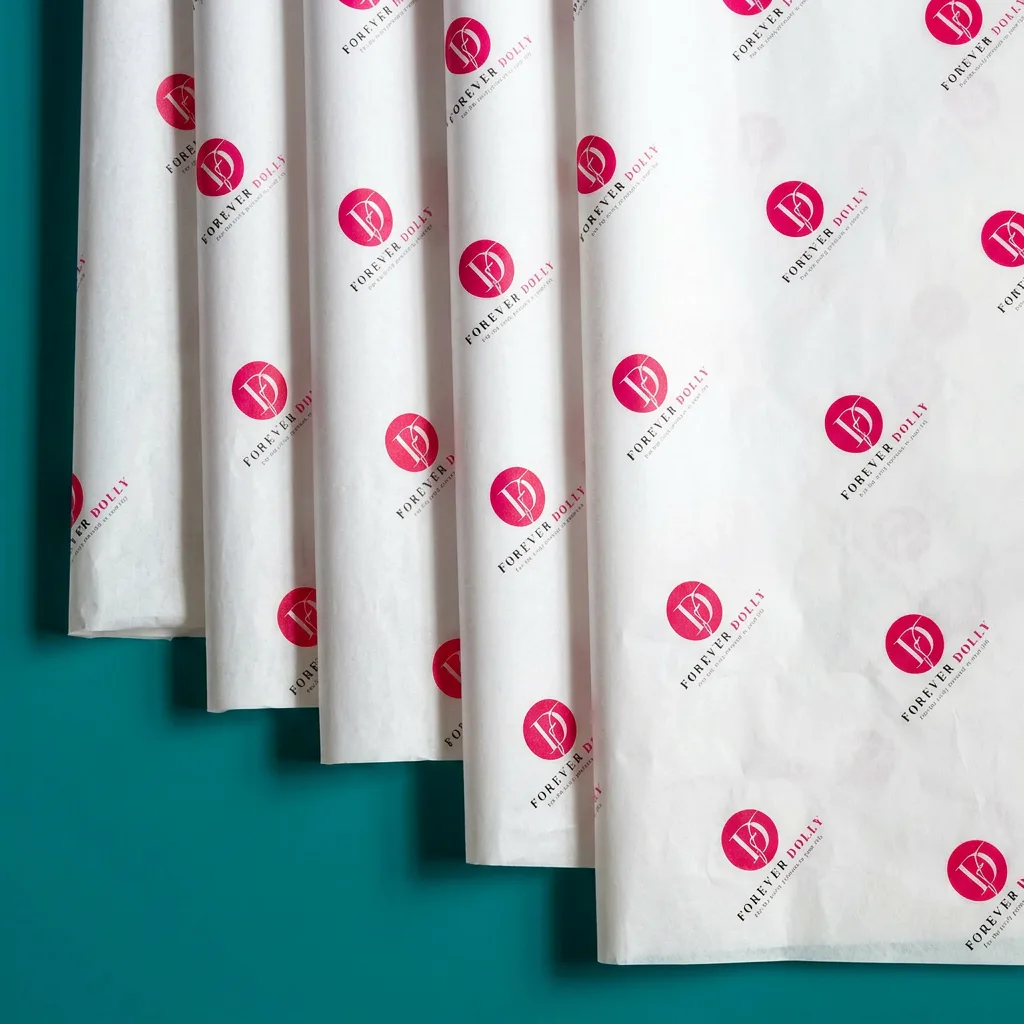
Available sheet sizes in mm, cm and inches
| Millimetres | Centimetres | Inches | Starting use to test |
|---|---|---|---|
| 220 × 300 | 22 × 30 | 8.7 × 11.8 | Small accessories or compact liners |
| 380 × 380 | 38 × 38 | 15.0 × 15.0 | Square gift boxes |
| 380 × 500 | 38 × 50 | 15.0 × 19.7 | Smaller garments and retail wrapping |
| 500 × 500 | 50 × 50 | 19.7 × 19.7 | Square wraps and box presentations |
| 500 × 700 | 50 × 70 | 19.7 × 27.6 | General clothing and mailer packaging |
| 600 × 900 | 60 × 90 | 23.6 × 35.4 | Bulkier garments or larger boxes |
| 700 × 1000 | 70 × 100 | 27.6 × 39.4 | Oversized wraps and hampers |
These uses are suggestions, not fit guarantees. A 500 × 700mm sheet is the same as 50 × 70cm; it is not exactly 20 × 30 inches. One inch is 25.4mm. If you are replacing an existing tissue sheet, measure it rather than relying on a supplier’s rounded name.
Sizes such as 300 × 400mm or 450 × 600mm are bespoke enquiries rather than listed builder options. Ask about a custom cut if the dimensions you need are not listed.
First decide: liner, fold-over or complete wrap?
- Flat liner: covers the base only. Measure internal length and width and test a small clearance so the paper sits flat.
- Fold-over box lining: covers the base, rises up the sides and folds across the product. Include the box depth and the overlap.
- Complete product wrap: encloses the item before it goes into the box. Measure the product in its packed shape, including any pouch or protective sleeve.
- Gift-bag display: creates a visible decorative top. Test it in the actual bag; handle position and the amount of paper showing matter as much as base dimensions.
Use internal box dimensions for liners and external product dimensions for wraps. Measure a folded garment as it will actually be packed, not when it is laid out flat.
Worked example: a fold-over box liner
For a rectangular box with internal length L, width W and depth H, one starting layout folds the tissue over the two sides along W. Let O be your chosen overlap across the top:
For a box measuring 300mm long × 200mm wide × 80mm deep, with an example 40mm overlap, the calculation is 600 × 460mm. A 500 × 700mm sheet can accommodate this when turned to the right orientation.
Cut scrap paper to the calculated size, place it in the box and add the product. Fold the two long flaps over it. Check that the contents do not push the fold higher than expected and that the lid shuts comfortably. Adjust the overlap and trim surplus paper before choosing the final size.
Worked example: wrapping a product completely
For a roughly rectangular product, the sheet must go around its width and height, then leave enough at each end to tuck closed. A useful starting point is:
Around the product = 2 × width + 2 × height + overlap.
Along the product = length + 2 × end allowance.
As a trial, start with an end allowance equal to the product’s height and adjust after folding. For a folded item 250 × 180 × 30mm, an example 30mm overlap gives a 450 × 310mm starting sheet. A 380 × 500mm sheet is a candidate to test.
Soft clothing can compress; a rigid gift box cannot. Bottles, handles and irregular shapes need a mock-up instead of a rectangular formula. Leave enough slack around corners to avoid pulling thin tissue tight.
The packing guide explains the folding sequence and how to keep the logo visible on the finished pack.
Custom cuts, sheet counts and print direction
Send the finished dimensions in millimetres and the number of usable pieces required. Include a photograph of your mock-up if the layout is difficult to describe. Confirm cutting costs, tolerances and the finished piece count in your quote rather than assuming a standard sheet and a cut piece mean the same thing.
For example, a 500 × 700mm sheet can geometrically divide into four 250 × 350mm pieces before any production allowances. That does not mean an order for 1,000 finished sheets automatically supplies 4,000 pieces. State which quantity you want delivered.
- Show which way the logo should face when the sheet is laid out for packing.
- Specify whether artwork may be trimmed at the edges or whether a complete logo must stay inside each piece.
- Ask for the print template and approved margins before placing a border near the cut line.
- For multiple sizes, list the quantity and layout for each so they can be quoted accurately.
Does a smaller sheet cost less?
A smaller sheet can reduce the paper used per pack and the time spent folding excess material. It does not always reduce the purchase price: setup, parent-sheet use and cutting also affect the cost.
In the current builder, sizes up to 500 × 700mm use the same base price for a matching weight, print option and quantity. The 600 × 900mm and 700 × 1000mm options carry a size uplift. Check your chosen specification in the builder for an instant price.
Before ordering, pack several examples of your smallest and largest products. Record sheets used, time taken and any tearing. A single versatile size may simplify stockholding; two sizes may suit a product range with very different dimensions.
Common questions
What is the standard tissue paper size?
Big Tissue’s standard size is 500 × 700mm, or 50 × 70cm. The online builder offers seven sizes from 220 × 300mm to 700 × 1000mm. Choose by testing your intended wrap rather than assuming standard means it will fit every box.
Is tissue paper A3 or A2?
Not necessarily. A3 is 297 × 420mm and A2 is 420 × 594mm. Neither is the same as a 500 × 700mm tissue sheet. Use actual millimetre dimensions when comparing or ordering.
Can I order a size that is not in the builder?
Send the finished dimensions, quantity and artwork orientation for a bespoke quote. Confirm cutting arrangements, tolerances and whether the quoted quantity means finished pieces or parent sheets.
Should I measure the inside or outside of my box?
Use internal dimensions, including depth, when lining a box. Use the external dimensions of the packed product when wrapping it separately. Try a paper mock-up with the real contents before finalising the order.
Continue planning your packaging
Folding and packing techniques
Turn your measured sheet into a consistent finished pack.
Choose the paper weight
Compare how 17gsm and 30gsm feel and fold.
More sizing examples
Explore fit checks for boxes and different products.
Reduce packaging waste
Review material use and disposal as well as sheet size.